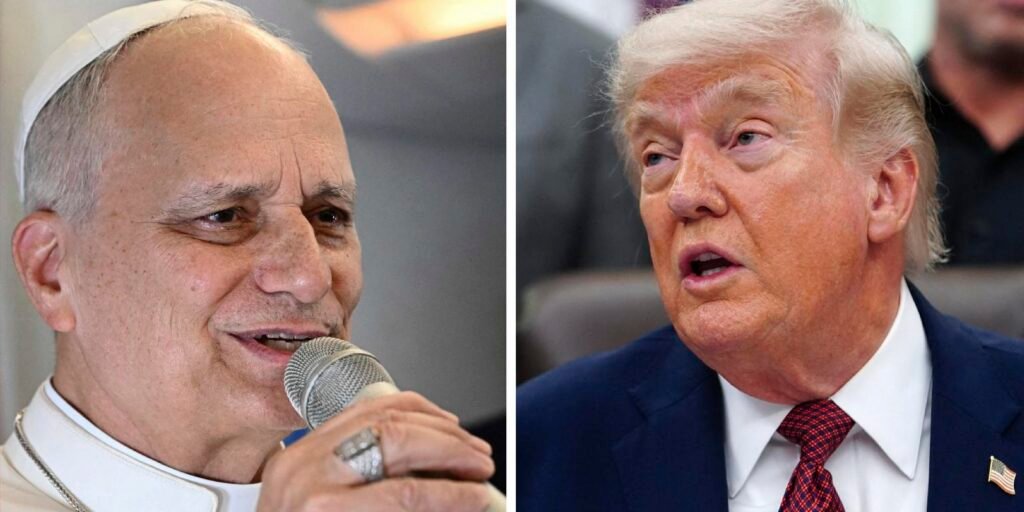
WASHINGTON (OSV News) — President Donald Trump’s social media and verbal attacks on Pope Leo XIV could add to challenges facing Republican candidates in the midterm elections later this year, analysts told OSV News.
While Trump, who is term-limited, will not be on ballots in November, his party is seeking to defend its control of both chambers of Congress, as polls show Democrats currently hold a 6-point advantage over Republicans on a generic congressional ballot.
Ryan Burge, author of the Substack newsletter “Graphs about Religion” and a professor of practice at the John C. Danforth Center at Washington University in St. Louis, told OSV News, “Catholics are roughly 21% of the Republican electorate, concentrated in exactly the competitive states (Pennsylvania, Wisconsin, Michigan) that decide midterms.”
“Trump won’t be on the ballot, but Republican candidates in those states now have to answer for a president who publicly feuded with the first American pope,” Burge said.
Catholic voters as a whole have varied in recent presidential elections about which party most of them choose to support. For example, election data shows that most Catholic voters supported Al Gore in 2000, George W. Bush in 2004, Barack Obama in both 2008 and 2012, Trump in 2016, Joe Biden in 2020, and Trump again in 2024.
Trump’s approval rate among Catholics has dropped
In the upcoming midterm cycle, the three states currently ranked as having toss-up Senate races by the nonpartisan Cook Political Report — Ohio, Maine and Michigan — each have Catholic populations of around 15%. Several competitive House races are in the Rust Belt states of Pennsylvania and Wisconsin, which both have Catholic populations of more than 20%.
Competitive House races are also in New York and New Jersey, states that have Catholic populations of more than 30%. Estimates of the Catholic population of Texas vary from 18-22%, but similarly conclude that most Catholics in the state are Latino.
Andrew Chesnut, who holds the Bishop Walter F. Sullivan Chair in Catholic Studies at Virginia Commonwealth University, said that since the 2024 election, “Trump’s approval rate among Catholic voters has dropped 10 points since the election and even more among Hispanic Catholics, approximately 13 points.”
“While Trump’s immigration policies have lost support among both white and Hispanic Catholics, it’s much more pronounced among Hispanics, plummeting from an already low 41% to just 22% support now,” Chesnut said. “Among white Catholics, support for his immigration policies have dropped 10 points but a majority, approximately 53%, still back him.”
Iran conflict and migration are reasons for erosion of support
“Just 40% of Catholics approve of Trump’s handling of the Iran conflict and it’s been a major reason for the overall erosion of support,” Chesnut said.
An April 21 Reuters/Ipsos poll found just 36% of Americans said they approve of Trump’s job performance. Conversely, 60% of respondents said they had a favorable view of Pope Leo.
Pope Leo’s favorable rating also exceeded that of prominent Democrats seen as likely contenders for their party’s nomination in 2028, such as Gov. Gavin Newsom, D-Calif, and former Vice President Kamala Harris.
In a post on X referencing that poll, notable pollster Larry Sabato, the founder and director of the Center for Politics at the University of Virginia, wrote, “Pope Leo at 60% favorable. Trump at 36%. No commentary needed.”
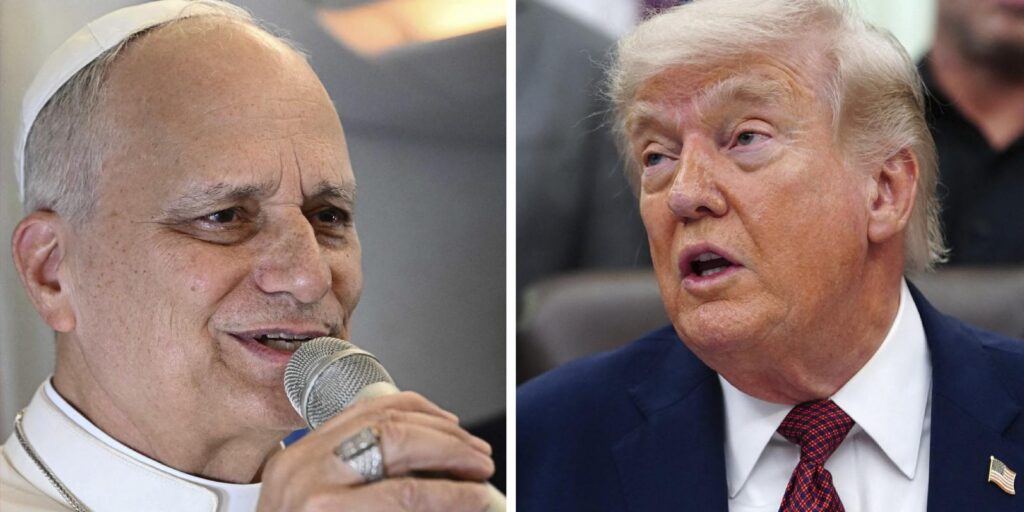
Asked about how Catholic views of Trump have shifted since the 2024 election, Burge said, “Trump’s approval among white Catholics has dropped from 59% to 52% since February 2025; among Hispanic Catholics, it fell from 31% to 23%.”
The primary driver of that dip, Burge said, were certain immigration enforcement actions, notably “the deportation of U.S. citizens and deaths in Minneapolis,” referring to Renee Good and Alex Pretti, two American citizens killed by federal agents in separate incidents in Minnesota.
“The irony is that a majority of Catholic voters still supported large-scale deportations as recently as November, so this isn’t a clean ideological break,” Burge said, pointing to those actions that Catholics and the public found “stomach-turning.”
The Iran war, Burge said, “compounded it.”
Chesnut said that, as a historian, he does not typically make political forecasts, but said trends suggest white Catholics may continue “to vote majority Republican but by smaller margins than in recent elections, and Democrats will recover a large percentage of the Hispanic Catholics who voted Republican in recent electoral contests.” He pointed to key off-year gubernatorial elections in New Jersey and Virginia in 2025 as a possible signal of voter behavior in November.
Outcry about AI-generated image
The same week as his comments about Pope Leo, Trump posted and deleted an AI-generated image that appeared to depict him as Jesus after outcry from even some of his supporters.
Daniel Alvarez, a professor of religion at Florida International University, who said he comes out of an evangelical tradition, told OSV News that while he sees roughly 40% of the GOP base as incredibly loyal to Trump, incidents such as the AI-Jesus image may leave others with “second thoughts.”
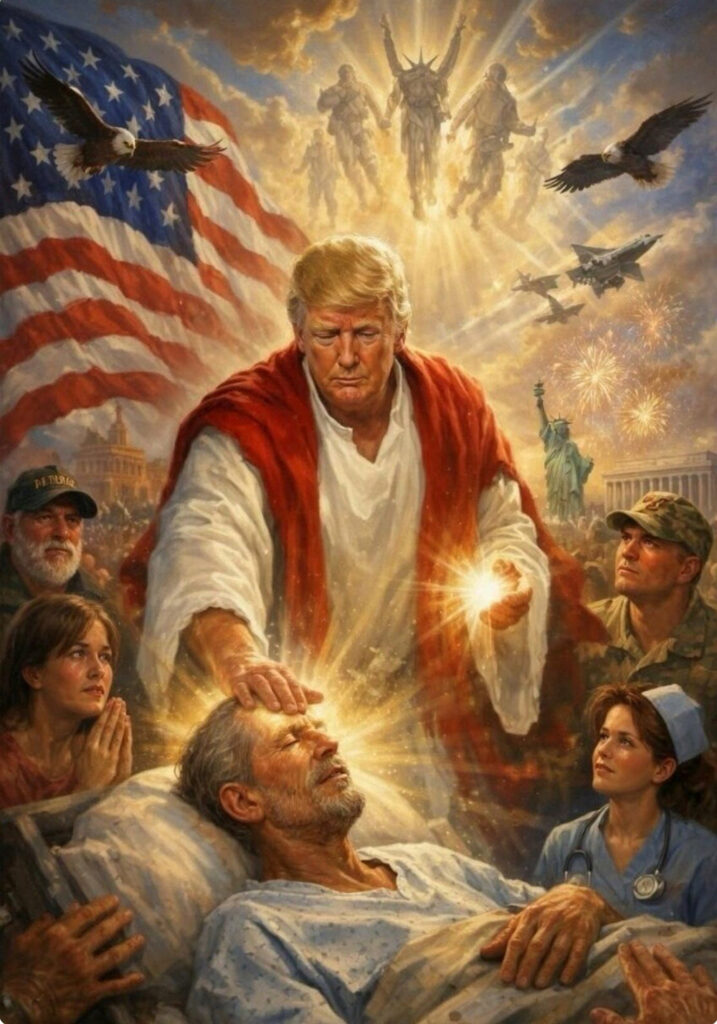
That image, Alvarez said, as well as the Pope Leo controversy, cost of living issues and dissatisfaction around the Iran war may create a “problematic, precarious” environment for Republicans in the midterms, he said, “and Trump is, frankly, the one most responsible for the disaffection of a sizable number of voters that are going to bail out on the Republicans in the midterms.”
Alvarez noted that Trump’s Protestant support is much higher than his Catholic support, pointing to data showing 81% of white evangelical Protestants voting for Trump in 2024, compared to 61% of white Catholics. A majority of Hispanic Protestants supported Trump, while a majority of Hispanic Catholics supported Harris.
Burge also noted that “Evangelicals and Catholics are different constituencies. No matter how you slice it, a Catholic is 12-15 points less conservative than an evangelical,” Burge said. “And that’s controlling for all kinds of factors. That means that they are more willing to defect from the GOP and Trump when things go sideways.”
Kate Scanlon is a national reporter for OSV News covering Washington. Follow her on X @kgscanlon.
The post Analysis: Will President Donald Trump’s criticism of Pope Leo XIV have electoral implications? first appeared on OSV News.