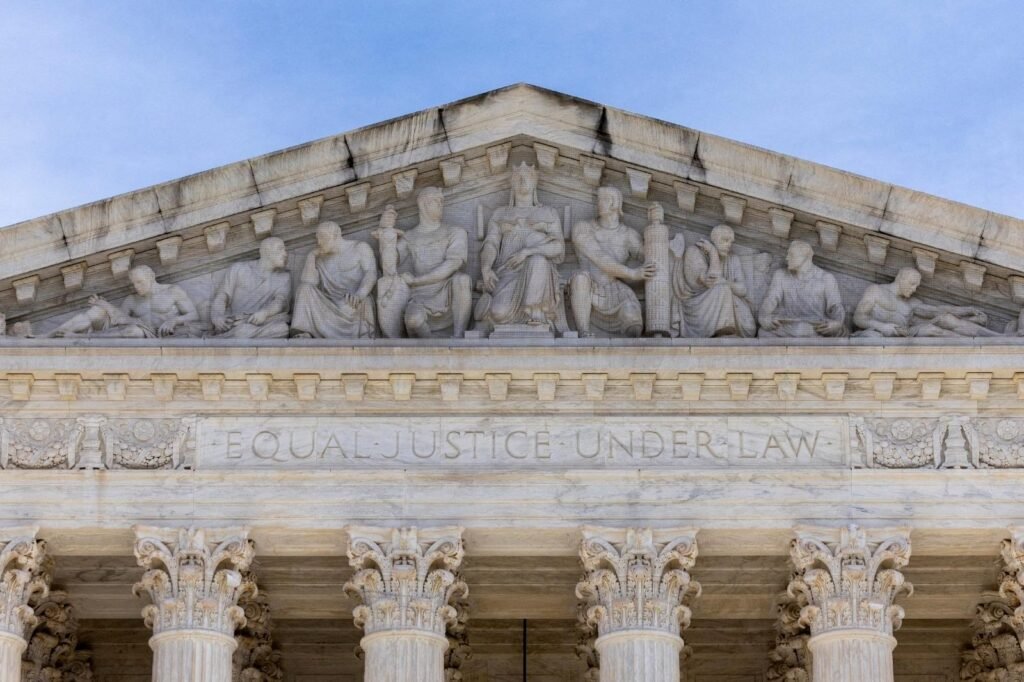
WASHINGTON (OSV News) — The U.S. Supreme Court struck down President Donald Trump’s sweeping tariff policy Feb. 20, finding it exceeded his authority, marking a major setback for his economic agenda.
In effect, a tariff is a tax imposed by a government on imported goods. Trump has argued his tariffs would protect U.S. manufacturing, but some economists have cautioned they will raise consumer prices on many goods and could lead to a recession. Catholic economists, pointing out the Church’s preferential option for the poor in its social teaching, have also pointed out the burden of those tariffs disproportionately falls on Americans with the lowest incomes.
Court strikes down tariffs policy in 6-3 ruling
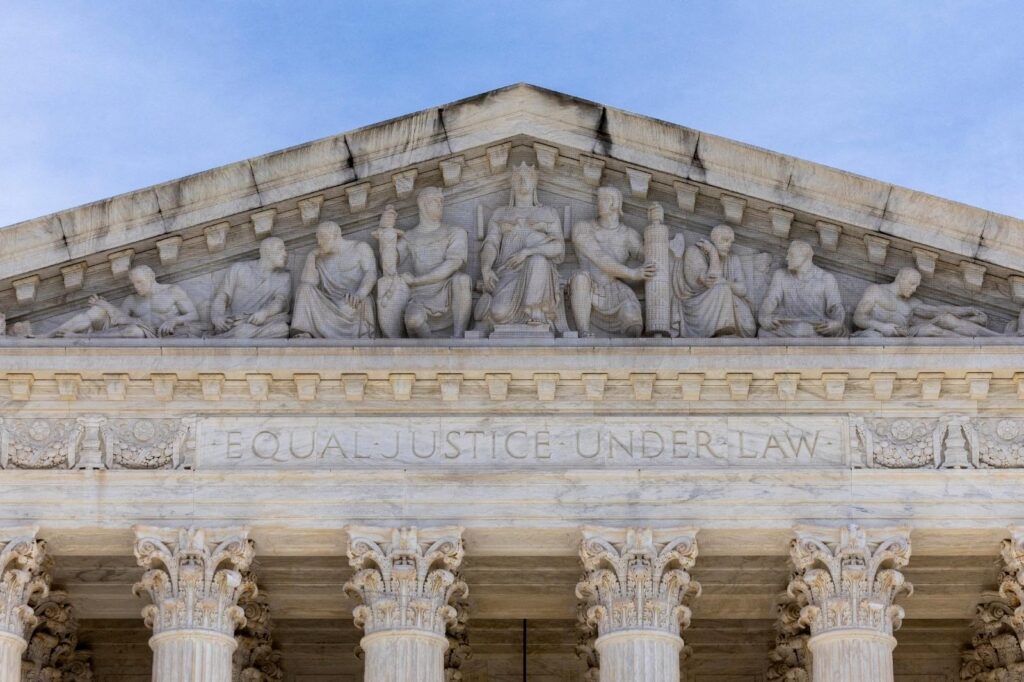
In a 6-3 ruling, the high court rejected the Trump administration’s claim that the 1977 International Emergency Economic Powers Act, or IEEPA, granted the president unilateral power to impose sweeping tariffs on nearly every country around the globe, finding that the law does not grant him that authority.
“It stands to reason that had Congress intended to convey the distinct and extraordinary power to impose tariffs, it would have done so expressly — as it consistently has in other tariff statutes,” Chief Justice John Roberts wrote in the opinion of the court.
Justices Clarence Thomas, Samuel Alito, and Brett Kavanaugh dissented from the ruling.
Kavanaugh wrote in his dissent that one issue “will be refunds.”
“Refunds of billions of dollars would have significant consequences for the U. S. Treasury,” he argued. “The Court says nothing today about whether, and if so how, the Government should go about returning the billions of dollars that it has collected from importers.”
Refunds not likely to go to those hit hardest
Tyler Schipper, an associate professor of economics at the University of St. Thomas in St. Paul, Minnesota, called the ruling a good check on the president’s use of tariff power. But he told OSV News Trump might pursue other avenues to impose them under other tariff authorities.
“While most economists will applaud today’s decision, its impact is unlikely to be felt by those who most need relief,” Schipper said. “Tariffs have raised prices for everyone, but any refunds resulting from the ruling will flow to companies — not consumers. People should not expect lower prices on store shelves or a refund check in the mail.”
Schipper previously told OSV News that there are situations where tariff policy can support elements of Catholic social teaching. However, he pointed out the problem with the across-the-board tariffs — such as the ones the Supreme Court has now struck down — “is that they are regressive” and they “fall hardest among those with the least.”
He pointed to Yale Budget Lab estimates that “the bottom 10% of the income distribution will pay more than 3x more as a percentage of their income than the top 10% of the income distribution.”
Religious goods industry professionals also previously told OSV News the tariffs created uncertainty for their businesses.
Trump undeterred, blasts justices
In comments to reporters at the White House shortly after the ruling, Trump called the ruling “deeply disappointing.” He praised the justices who dissented and blasted the majority as “very unpatriotic and disloyal to our Constitution.”
Trump suggested he would seek other legal avenues to impose tariffs on imported goods. He said he will sign an executive order to impose tariffs under a different statute, Section 122 of the Trade Act of 1974. But that statute only permits such action for 150 days unless Congress votes to extend the tariffs.
Former Vice President Mike Pence, a critic of the tariff policy issued by his former running mate, said in a statement on X that the ruling was “a victory for the American people and a win for the separation of powers enshrined in the Constitution of the United States.”
“In Learning Resources, Inc. v. Trump, our Supreme Court has reaffirmed that the Constitution grants Congress — not the President — the power to tax,” he said, referring to the name of the case. “American families and American businesses pay American tariffs — not foreign countries. With this decision, American families and businesses can breathe a sigh of relief.”
For the court, tariffs are about Congress
Rick Garnett, a professor of law at the University of Notre Dame in Indiana, told OSV News in written comments that it is tempting, but “a mistake” nevertheless, to look at the Supreme Court’s cases in terms of whether they are “wins” or “setbacks” for the president.
“In fact, the questions that divided the justices, and that prompted the various opinions, were not about the wisdom of the President’s tariffs and were certainly not about the merits of the Trump administration,” he said. “The question before the justices was a lawyerly, legal one, not a political or policy one: It is whether the particular words of a particular statute in fact authorize the tariffs. Congress has the power to authorize them; the question is whether Congress, in fact, did so.”
Kate Scanlon is a national reporter for OSV News covering Washington. Follow her on X @kgscanlon.
This story was updated Feb. 20, 2026, at 3:13 p.m. EST.
The post Supreme Court strikes down Trump tariffs, but relief for poorer Americans uncertain first appeared on OSV News.