CHICAGO (OSV News) — On Easter Monday, April 6, NASA’s Artemis II mission — the first crewed lunar mission in more than 50 years — reached its pinnacle as it flew past the far side of the moon.
As a people who profess belief in a God who is the creator of the universe, Catholics have always had a great interest in space exploration.
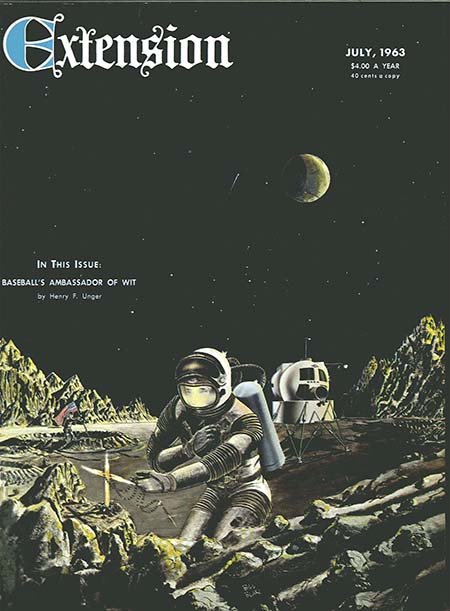
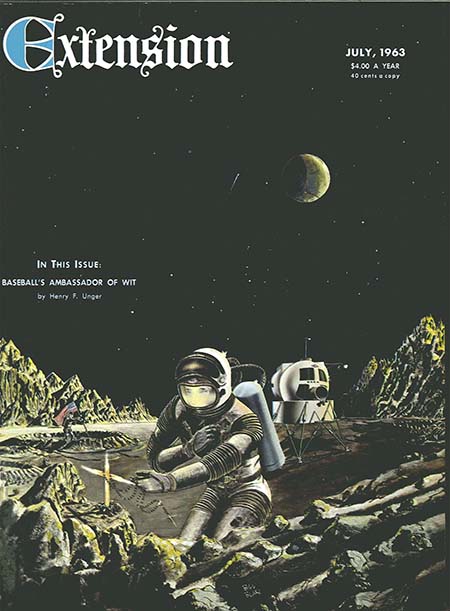
Only nine months after President John F. Kennedy’s “moonshot speech” on Sept. 12, 1962, in which he laid out America’s ambition to send people to the moon, Catholic Extension Society adorned its July 1963 magazine cover with a creative image of an astronaut praying on the moon’s surface.
NASA’s Apollo 11 mission
Six years later, on July 20, 1969, NASA’s Apollo 11 mission successfully landed the first two humans on the surface of the moon. Neil Armstrong became the first human to walk on the moon, declaring, “That’s one small step for man, one giant leap for mankind.” Buzz Aldrin followed Armstrong, while Michael Collins orbited above.
On that momentous occasion, St. Paul VI sent a congratulatory message to the moon explorers from America. It was his hope that this exploration would lead us to see God’s power more clearly.
He told the explorers, “Through your intrepid adventure, man has taken another step toward knowing more of the universe.”
Rational inquiry and natural science
In his 1998 encyclical, “Fides et Ratio” (“Faith and Reason”), St. John Paul II reminded all that faith, rational inquiry and natural science are complementary and not contradictory disciplines. Several years earlier, in a speech to the Pontifical Academy of Sciences, he even retracted the Church’s condemnation of Galileo in 1633 for asserting that the Earth traveled around the sun.
He said that the Church’s mistake was to “unduly transpose into the realm of the doctrine of faith a question which in fact pertained to scientific investigation.”
The Vatican has had its own observatory since it was founded by Pope Leo XIII in 1891 to promote scientific inquiry. The observatory is located at the pope’s summer retreat in Castel Gandolfo, outside Rome, to mitigate light pollution. Its current director is a Jesuit priest, Father Richard A D’Souza.
Pope Benedict and International Space Station
On May 21, 2011, Pope Benedict XVI was the first pope to speak live with astronauts at the International Space Station. On that occasion he called the Earth a “beautiful fragile oasis,” speaking of “the responsibility we all have toward the future of our planet.”
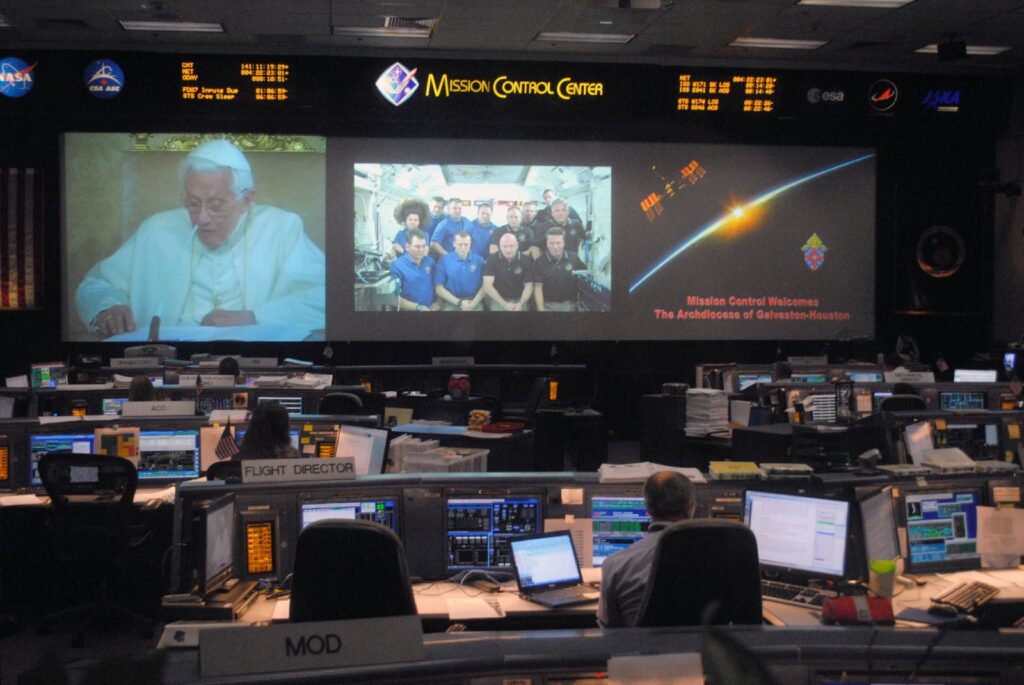
Additionally, he spoke of our common humanity, given that from the vantage point of space, there are no borders separating nations.
“I think it must be obvious to you (astronauts) how we all live together on one earth, and how absurd it is that we fight and kill each other,” Pope Benedict said from the Vatican via a video link to the space station.
He continued with this question to the astronauts that rings more true today than ever: “When you are contemplating the Earth from up there, do you ever wonder about the way nations and people live together down here, or about how science can contribute to the cause of peace?”
Pilot of Artemis II mission
Pope Benedict might have appreciated the comments by the pilot of the Artemis II mission, astronaut Victor Glover. He seemed to answer that question 25 years later in speaking to CBS News April 5 from aboard NASA’s Orion spacecraft Integrity.
“I think, as we go into Easter Sunday, thinking about all the cultures all around the world, whether you celebrate it or not, whether you believe in God or not, this is an opportunity for us to remember where we are, who we are, and that we are the same thing, and that we’ve got to get through this together,” Glover told CBS.
As Glover and his fellow astronauts reached their closest approach to the moon, the team’s pilot reminded the Earth of Jesus Christ’s command to love both God and neighbor.
‘Love your neighbor as yourself’
“I would like to remind you of one of the most important mysteries there on Earth, and that’s love,” Glover told ground control April 6. “Christ said, in response to what was the greatest command, that it was to love God with all you are. And he also, being a great teacher, said the second is equal to it. And that is to love your neighbor as yourself.”
The Artemis II mission, which launched April 1 from the Kennedy Space Center in Florida, was set to conclude April 10 with a splashdown in the Pacific Ocean off the coast of San Diego at about 8 p.m. EDT.
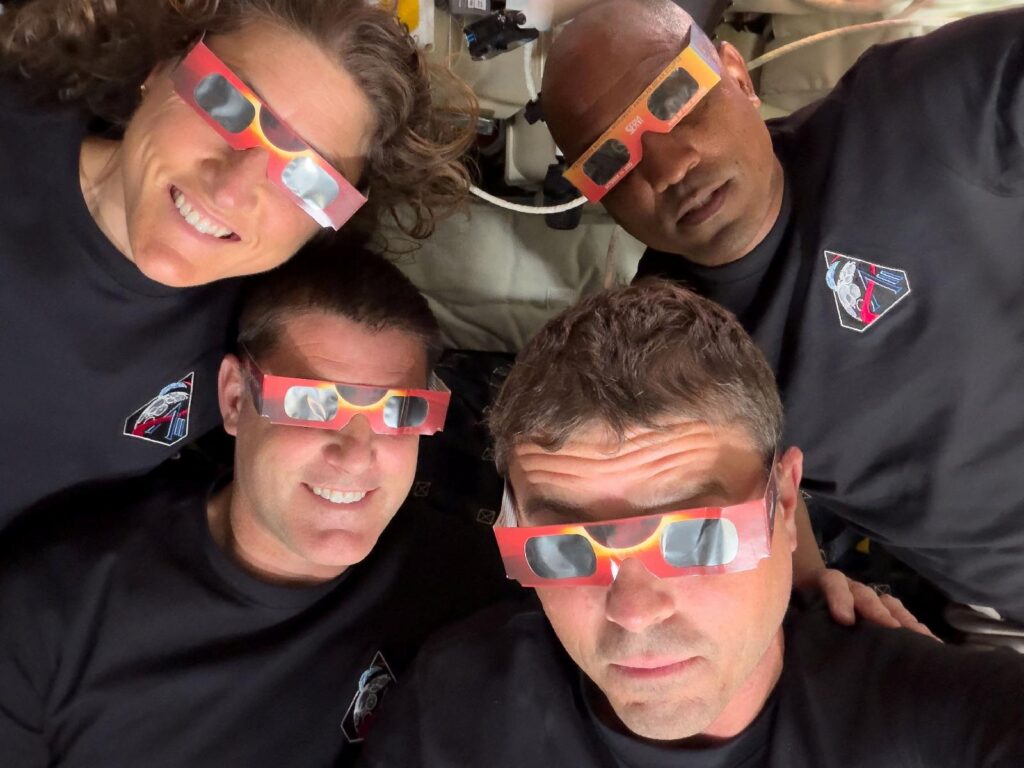
Pope Francis continued the papal tradition of speaking live with the crew of the International Space Station in 2017. As the author of “Laudato Si’,” the first papal encyclical on care for creation, he spoke of the Earth’s vulnerability saying it “has an atmosphere so fine it can be destroyed.”
Vatican’s astrophysics summer camp
Later in 2023, Pope Francis offered a message to young people participating in the Vatican’s astrophysics summer camp, urging them to never lose their “sense of wonder.”
Pope Leo XIV visited the Vatican Observatory on July 20, 2025, to mark the anniversary of NASA’s Apollo 11 mission. He looked through its main telescope and viewed its other instruments after praying the Angelus in the city’s main square.
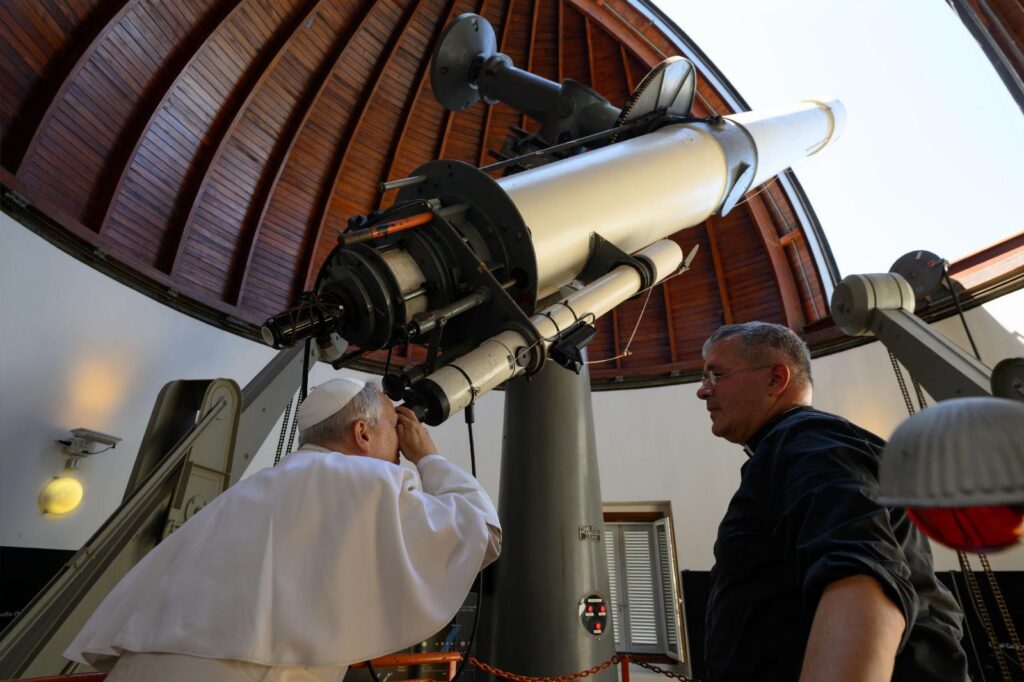
Throughout the years, the popes have urged that scientific advance must be at the service of humanity and must never do harm to the dignity or rights of humans.
Today, as Americans and as Catholics, we can rightfully celebrate humanity’s return to the far reaches of space in the hopes that our exploration will bring us closer to the one who made the universe, and who through the miracle of Easter, promises to renew all of creation.
This story originally appeared on the website of Catholic Extension Society and is distributed through a partnership with OSV News.
The post Artemis II mission prompts look at Catholics’ longtime interest in space exploration first appeared on OSV News.