(OSV News) — Several U.S. bishops recently traveled on pilgrimage to key sites commemorating the nation’s Civil Rights Movement and the legacy of slavery and racial discrimination — with two bishops telling OSV News the journey showed the need to face the past, before seeking to change the future.
“It’s important to learn about the past, as odious as this is, as evil as the sin of racism and slavery is,” said Bishop William A. Wack of Pensacola-Tallahassee, Florida. “We have to admit it, that it was part of our history, part of our nation, really a part of our culture. … It’s hard to move on if we have not confronted it together.”
‘Lenten Experience’ for U.S.bishops
Bishop Wack was among six prelates who traveled to Alabama for a March 18-20 “Lenten Experience in Montgomery and Selma.”
Joining Bishop Wack were Bishop Jaime Soto of Sacramento, California; Bishop J. Mark Spalding of Nashville, Tennessee; Bishop Joseph R. Kopacz of Jackson, Mississippi; Auxiliary Bishop Evelio Menjivar-Ayala of Washington; and Auxiliary Bishop Felipe Pulido of San Diego.
The second such event coordinated by the U.S. Conference of Catholic Bishops‘ Subcommittee for the Promotion of Racial Justice and Reconciliation and the Catholic Mobilizing Network, the trip saw the bishops — along with USCCB and network staff, and USCCB subcommittee consultant Gloria Purvis — visit multiple locations in just two and a half days.
Celebrating Mass at local parishes
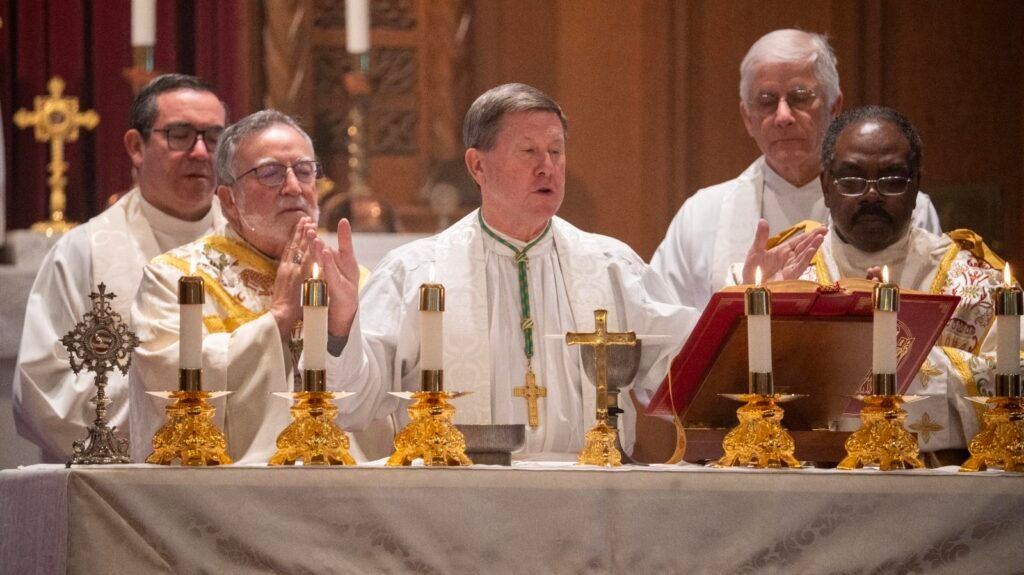
During the pilgrimage, the bishops celebrated Mass at local parishes, and met with civil rights attorney Bryan Stevenson, founder of the Equal Justice Initiative, as well as Dianne Thelma Harris, a foot soldier in the peaceful 1965 Voting Rights March.
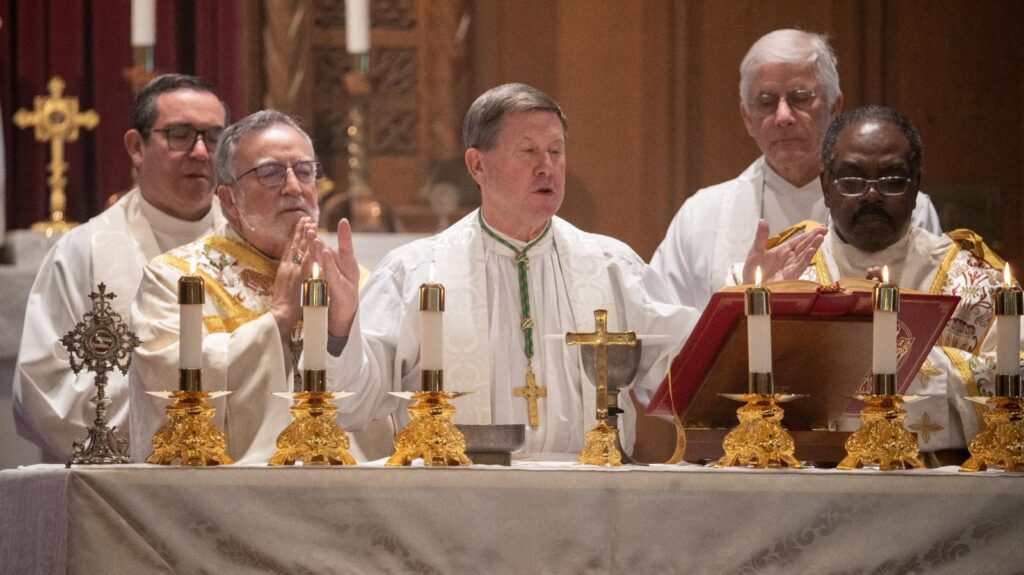
The itinerary featured stops at Montgomery’s three Legacy Sites: the Legacy Museum, which surveys the nation’s 400-year span of enslavement, racial terrorism, codified segregationism and mass incarceration; the National Memorial for Peace and Justice, which memorializes more than 4,400 Black people lynched between 1877 and 1950; and the Freedom Monument Sculpture Park, which provides an immersive view into the lives of enslaved persons.
Final stop for Civil Rights marchers
Other Montgomery sites in the tour were City of St. Jude, which was the final stop for Civil Rights marchers from Selma before their arrival at the state capitol on March 24, 1965, and the Dexter Parsonage Museum, where Civil Rights leader Rev. Dr. Martin Luther King, Jr. and his family lived during his 1954-1960 tenure as pastor of the Dexter Avenue King Memorial Baptist Church.
Bishop Wack told OSV News the parsonage — which had been bombed several times during Rev. King’s pastorate — left a deep impression, as he recalled a pivotal moment when Rev. King, sitting at his kitchen table after an attack, prayerfully discerned a call to persist in the Civil Rights Movement.
“He became a real person to me sitting right here — there’s the sink, here’s where he made the coffee. And then he sat down and he had this moment of deep, intense prayer with God,” Bishop Wack recalled. “As a bishop, I’ve had moments like that: ‘God, what do you want me to do? Where should I go?’”
Crossing Edmund Pettus Bridge
In Selma, the group crossed the Edmund Pettus Bridge, where in 1965 some 600 Civil Rights marchers for voting rights were brutally attacked by law enforcement, with the violence filmed by local television and later broadcast. While in Selma, the pilgrims dined at the Edmundite Missions, a Catholic social services agency through which the Society of St. Edmund has offered support for 90 years.
Bishop Kopacz told OSV News that the pilgrimage revealed “incredible truth and reconciliation opportunities.”
He pointed to the need to document the historical sweep of slavery, racism and injustice in the nation’s history, and to see its ongoing effects.
“What Alabama has done is really brought forward the history that goes back to the onset, to the the transatlantic passage and the beginnings of slavery,” he said.
12 million to 20 million Africans enslaved
The slave trade saw some 12 million to 20 million Africans enslaved in various Western nations, including the U.S., over a period of four centuries. The United Nations recently condemned the transatlantic slave trade as “the gravest crime against humanity,” and passed a resolution also calling for reparations by member states to affected nations.
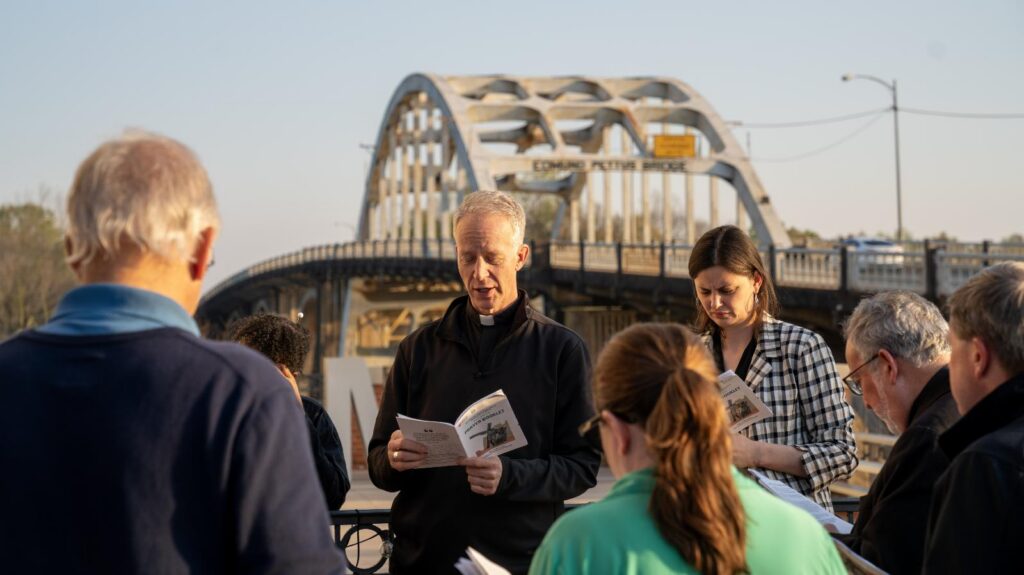
Recalling his visit, Bishop Kopacz traced how the legacy of slavery continued through “the years of Jim Crow,” the codified racial caste system that prevailed in southern and border states from 1877 to the mid-1960s; racial lynchings; and through capital punishment, which Stevenson and others argue disproportionately impacts people of color.
Bishop Kopacz said that capital punishment — which the Catholic Church condemns — is “dragging forward this chapter of our life here in America” marked by the violent history of slavery and racism.
Slavery didn’t end with Emancipation Proclamation
Slavery “wasn’t just ended with the Emancipation Proclamation,” said Bishop Wack, referencing the 1863 presidential decree that declared slaves in some U.S. states free.
Rather, said Bishop Wack, slavery “perhaps took different forms,” as “there was a lot of discrimination that continued.”
Both Bishop Kopacz and Bishop Wack told OSV News they planned to bring their pilgrimage experiences back to their respective flocks, encouraging prayer, reflection and — as Bishop Wack said — “courageous conversations” to help counter the sin of racism.
“In order to have reconciliation and change toward greater justice, we need that deepening awareness,” said Bishop Kopacz.
Gina Christian is a multimedia reporter for OSV News. Follow her on X @GinaJesseReina.
The post Bishops’ Civil Rights pilgrimage shows need to face past to build new future first appeared on OSV News.