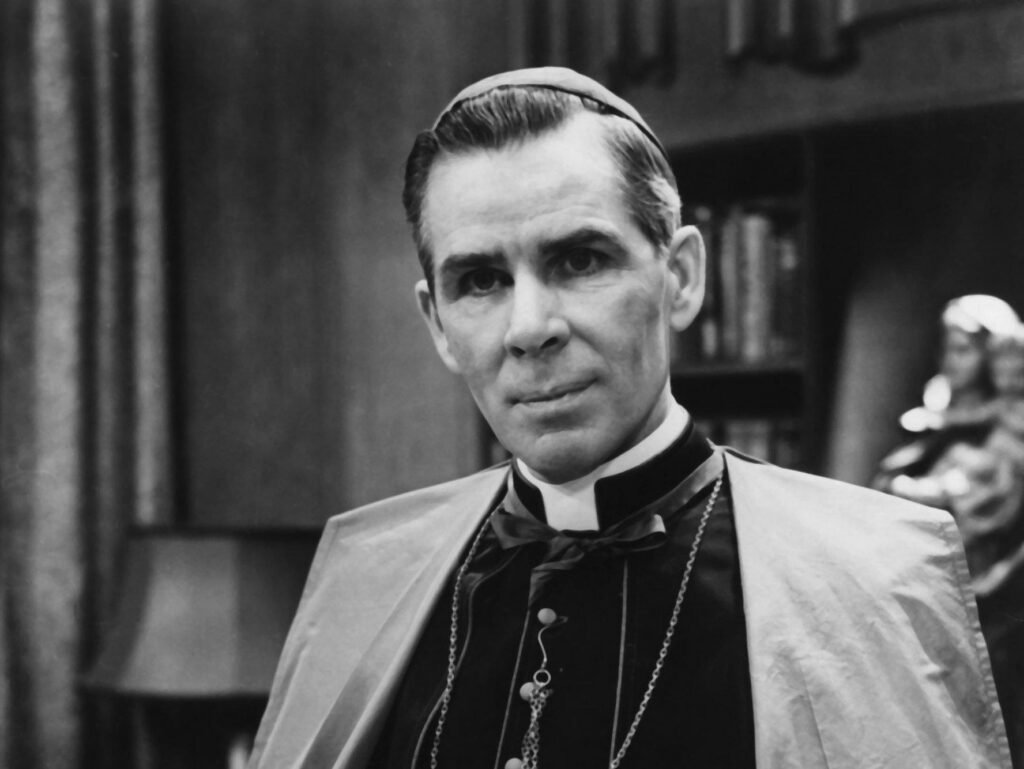
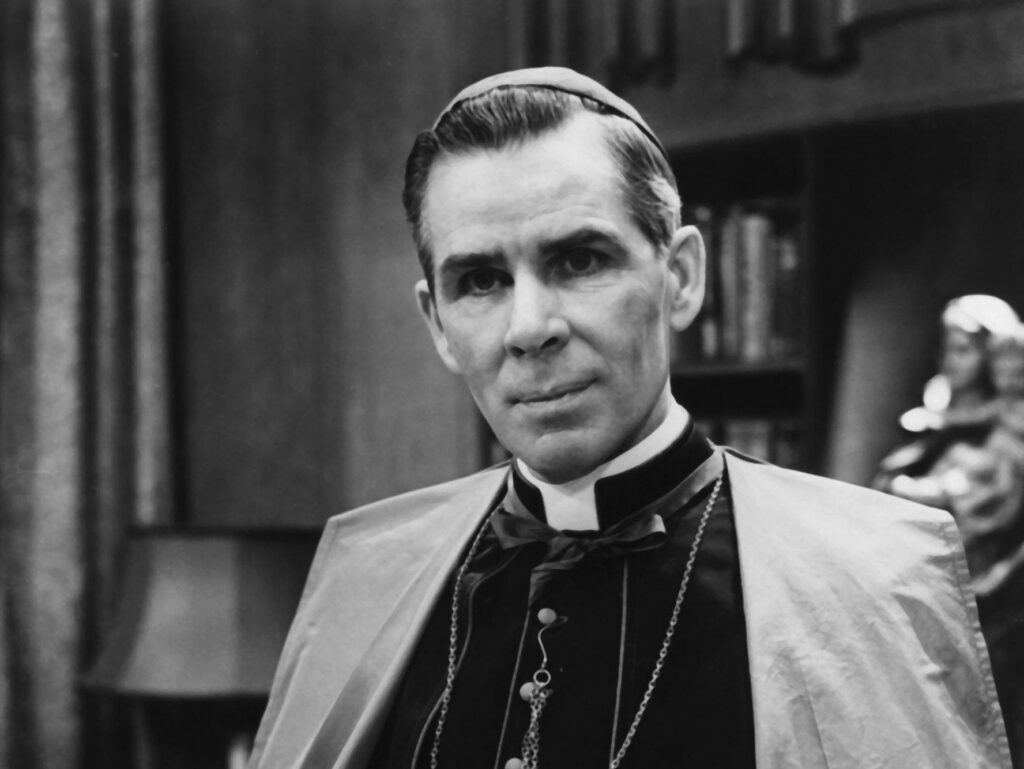
(OSV News) — With the Feb. 9 announcement from the Diocese of Peoria, Illinois, that the Vatican has authorized the beatification of Venerable Fulton J. Sheen to move forward, OSV News sat down with Cheryl C.D. Hughes, author of “Archbishop Fulton J. Sheen, Convert Maker” (Ignatius Press, 2024), to reflect on the life and legacy of the late theologian and evangelizer.
This interview has been edited for length and clarity.
OSV News: How would you sum up the life and legacy of Venerable Fulton J. Sheen?
Hughes: His holiness and his enthusiasm for saving souls, for converting people and bringing them to Jesus.
They say he converted more than 42,000 people; that’s something I came across in his positio (the dossier submitted to the Vatican laying out the case for an individual’s proposed canonization). Actually, I think that number — everyday people whose lives were impacted by listening to him, observing his holiness and his closeness to Jesus and to the Virgin Mary — is way too low.
OSV News: How is Archbishop Sheen relevant to the current moment in the life of both the Church and the U.S.?
Hughes: I think he is very relevant to this moment, and I’ll tell you why: Part of his main occupation was to critique the United States and its culture, really wanting to reform it. And for that, he kind of held up a mirror.
All the pathologies that he commented about in the 1950s are now here — the dissolution of the family, the politicization of educational systems. So I think that what he saw of America in the 1950s and 60s and even 70s, he would see now in greater numbers, and in more dire circumstances, I believe.
OSV News: What do you think he would say at this moment? Would it be anything different than what he said in his own time?
Well, he pointed to the Bible, stressing that God will prevail and that the Church will prevail. And I think he firmly believed that. … I think if we keep on being faithful to our faith, we can have some impact. But maybe it’s only just one person at a time.
I think he would say, “Get close to your rosary and get close to Jesus.”
And love. He was a big advocate of love; love is just so important in the world. And we often don’t move from a platform of love. I think our politicians go from platforms of power rather than love, our true concern.
So he (Archbishop Sheen) basically said, “I’m not a Democrat, I’m not a Republican, I’m a Catholic.” … I think he is as powerful today, if people would only read him and listen to him and heed his advice.
OSV News: Another interesting quality about Archbishop Sheen is that he was profoundly intellectual — effortlessly moving between philosophy, theology, political and cultural commentary — and yet he speaks very directly to the average person. Talk about how he was able to bridge all of those worlds.
Hughes: I think his high intellect really helped him to see more clearly what the issues were before him. He formed himself to know everything there was to know about communism, for instance. During the Cold War, he spoke out against communism. And yet when he reached out to communists, it was person to person. It was out of love that he approached them, really.
I think that’s how he was so influential, because people thought he was talking just to them.
If you look back at those episodes of (Archbishop Sheen’s 1952-1957 television show) “Life is Worth Living,” he is looking right into the camera, which means he’s looking right into the viewer’s eyes, because the viewer is looking at the camera.
And I think somehow the warmth of his personality took away the camera, as if they (the viewers) were sitting in his study, or he was in their living room visiting with them and talking with them about things that really mattered to them.
It was that sense of personal concern that he had for everyone he met. He was just the kindest person you would ever meet.
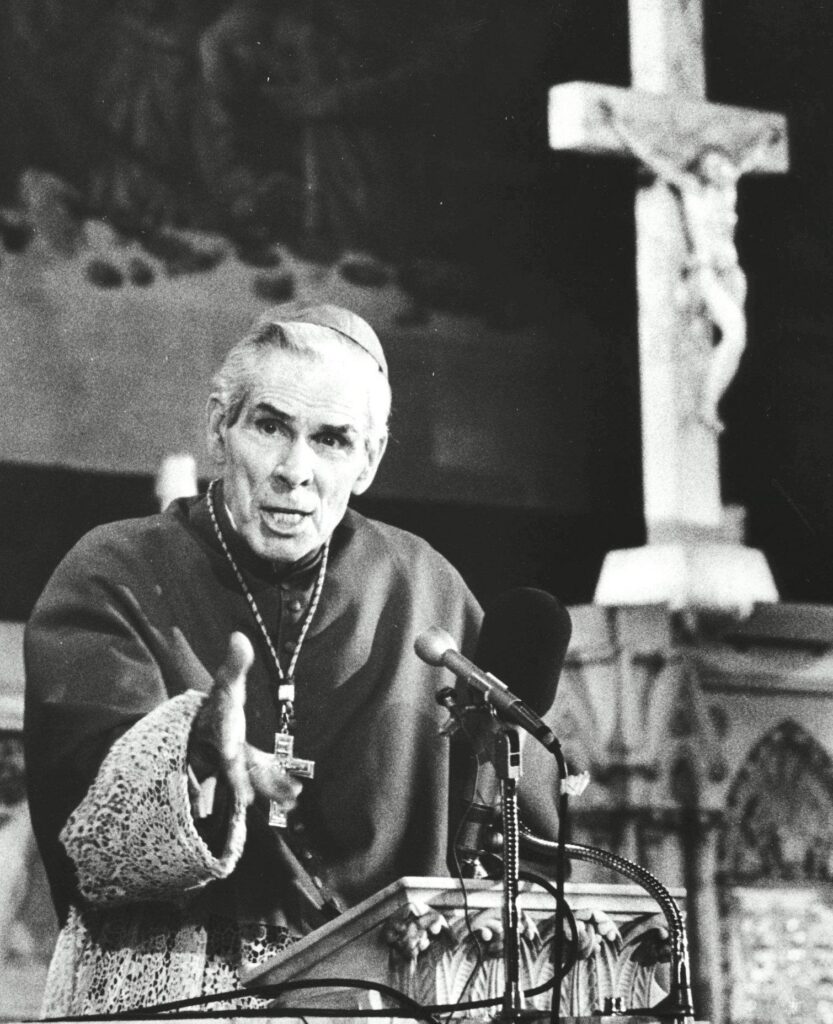
OSV News: He was also known for his personal generosity, as well as his ability to rally support for those in need, especially during his 1950-1966 tenure as national director of The Pontifical Mission Societies in the U.S., for which he raised millions.
Hughes: He gave away his coat twice. On a cold New York day, he saw somebody shivering and said, “Here, take my coat.”
He was being paid several thousands of dollars a night just to come and speak places. He could have luxuriated in all of his earnings. And what did he do with it? He gave it away. He gave away many of his royalties, mostly to the Catholic missions, because that was so near and dear to his heart.
He built a maternity hospital in Mobile, Alabama (the now-closed St. Martin de Porres Hospital) for Black women, because they weren’t allowed to deliver their babies in the only (area) hospital, which was exclusively for whites.
He was a “person-to-person” person. He was very intuitive when it came to individuals, about what they needed, what would be the best thing for them, the best tactic for opening the door to them.
And even though we call him the “convert-maker” and the positio says he converted 42,000, he would always say, “I’m just the doorkeeper. The Holy Spirit does the work.”
He really treated it that way, that the Holy Spirit did it, but he knew how to help that individual become susceptible to the moving of the Spirit. And I think that accounts for a lot of his success.
He had empathy for the human condition. Everyone to him was a child of God, and they were his brothers and his sisters.
OSV News: Archbishop Sheen had a profound love for the Eucharist, and he died while praying in his private chapel before the Blessed Sacrament. What do you think he would say about Eucharistic devotion in the U.S. at this moment, where we’ve just concluded the three-year National Eucharistic Revival amid a long decline in belief in the Real Presence?
Hughes: I think he would be preaching it up and down the streets. I think he would be scandalized by how many Catholics actually don’t believe in the Real Presence. When he gave retreats, he insisted that the monstrance with the host was there before everyone — because that was the locus of truth and beauty and goodness right there. So I think he would just encourage Eucharistic devotion more and more and more.
Gina Christian is a multimedia reporter for OSV News. Follow her on X @GinaJesseReina.
The post Biographer: Archbishop Sheen challenged US with love that he lived, fed by Eucharist first appeared on OSV News.