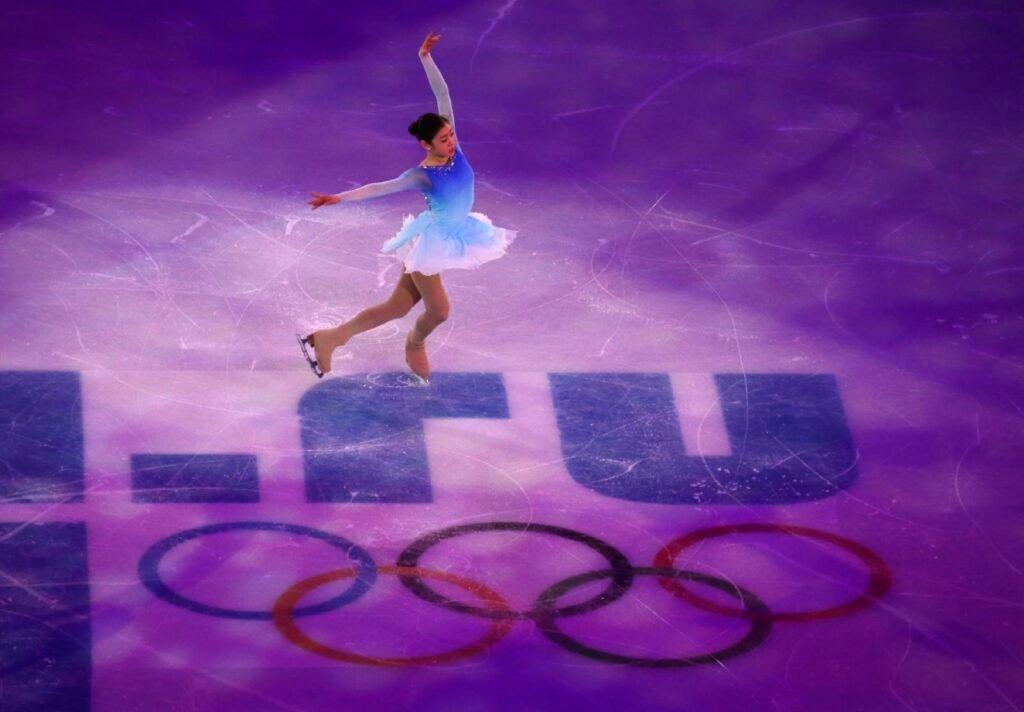
(OSV News) — As billions tune in to the Winter Games in Italy, many will recall highlights from past Winter Olympics over the decades.
The Catholic athletes at the Games this year are joining a long tradition of Catholic Olympians who have made history with their inspiring stories of faith and endurance. Here are just some of the Catholic stories that came out of past Winter Games.
‘Queen Yuna’ and a priest’s influence
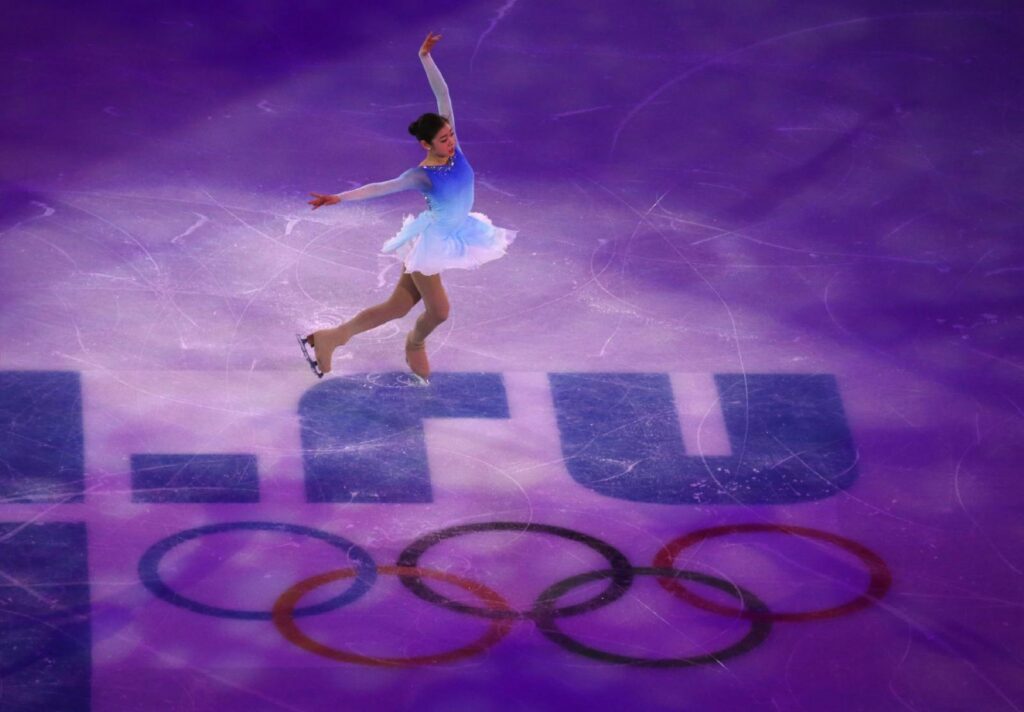
One of the most revered Olympic figure skaters of all time, Yuna Kim of South Korea, witnessed to her Catholic faith at two Olympics where she took home gold and silver medals in 2010 and 2014. Called “Queen Yuna” by figure skating fans, Kim converted to the faith in 2008 after an unlikely encounter with Catholic doctors and a priest.
“I had an injury, indeed a series of injuries, starting in 2006, which obliged me to be in and out of hospital,” she explained in a 2014 interview with the then-Pontifical Council for the Laity (now succeed by the Dicastery for the Laity, Family and Life). “In hospital I had a providential encounter with some Catholic doctors with whom I established a trusting relationship. They quoted sentences to me from the Bible and the New Testament, to keep up my morale and to comfort me, and all this was a great help in overcoming the psychological problems I had due to my continuous relapses after my injury.”
“I would say that what impressed me most was that they were not trying to convert me,” she added. “Theirs was a disinterested act for a girl who was going through a difficult time in her life and in her professional career; they sought to give me the best possible advice in accordance with their vision of the world.”
She described the recovery process as “the hardest time in my life” with back problems which “had been recurring for two years, it seemed as though I would have them forever. At a certain point you find yourself at a crossroads. You ask yourself if it is really worth going ahead and, if it is, where you can find the strength to continue to hope. I needed to be able to count on something or someone. Faith in Catholicism gave me all this. For me it was a completely unknown path. Neither my mother nor my father was a believer. But in hospital I met Father Lee.”
“He was not merely the clinic’s priest but he himself was also a patient at that time and a common destiny seemed to create a certain bond between us,” she said. “After meeting Father Lee, I began to understand more in detail the fundamental teachings of Catholicism; he gave me private lessons on the Bible and on the Gospels, in short he introduced me to the faith: hence my decision to be baptized with my mother.”
At her baptism, Kim took the name “Stella” after the Marian title “Stella Maris,” Star of the Sea, telling a diocesan paper that during the baptism she “felt an enormous consolation in my heart,” and she promised God to continue to “pray always,” especially before competitions.
She joined with Korean bishops in 2010 to explain the rosary through the example of the rosary ring she wore in competition.
Tara Lipinski and the Little Flower
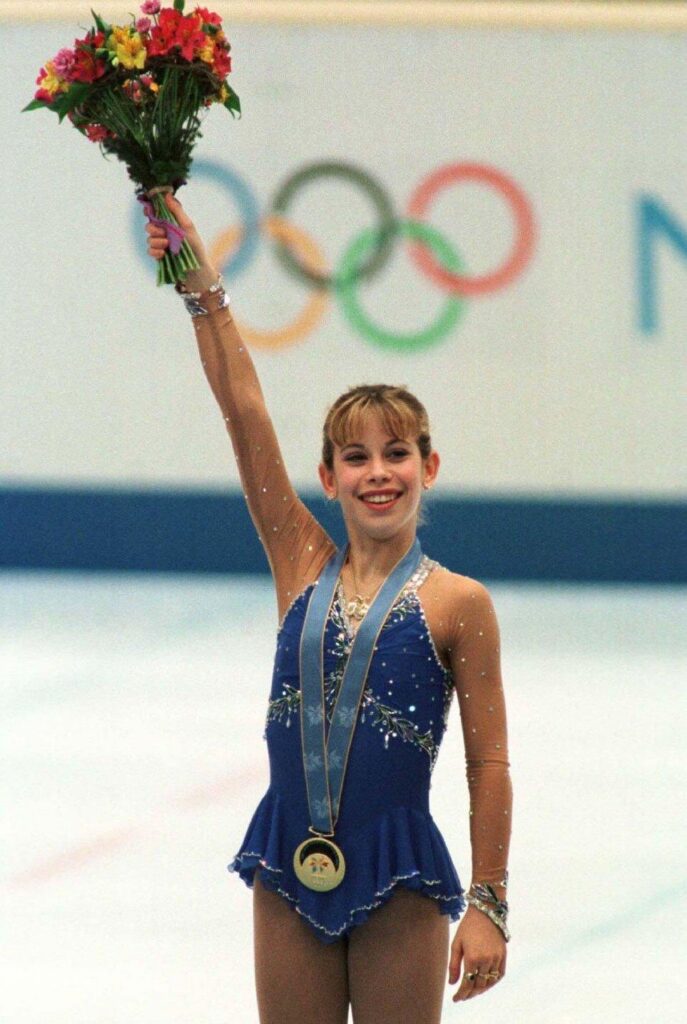
Another revered Olympic figure skater and current NBC figure skating commentator, Tara Lipinski, who won a gold medal in the 1998 Winter Games, attributed her success, in part, to the intercession of St. Thérèse of Lisieux, the Little Flower.
Lipinski, whose mother, Pat, felt renewed in her Catholic faith after a novena to St. Thérèse, said in a 2001 interview with the Pittsburgh Post-Gazette that she liked the saint “because she didn’t seem perfect, which makes you feel you have something in common with her.”
She related to St. Thérèse’s battles with perfectionism, saying it was comforting to know that the saint could be “a little bratty.”
“She was struggling to get into the convent kind of like I was struggling to be accepted, because I was too young,” she added. Lipinski won her Olympic gold medal at just 15 years old.
Before her long program in Nagano, Japan, her coach held her statue of St. Thérèse while Lipinski took the ice. “I remember being on the ice and feeling such a strong presence of her being there with me,” she said of the saint. “She was on my mind constantly. It kept my mind off of doubting myself or technical things.”
“I think she’s changed me as a person,” Lipinski said. “She crosses my mind often. I think, what would she do? Her Little Way applies to everything in life.”
A skier’s Olympic ring for St. Pier Giorgio Frassati
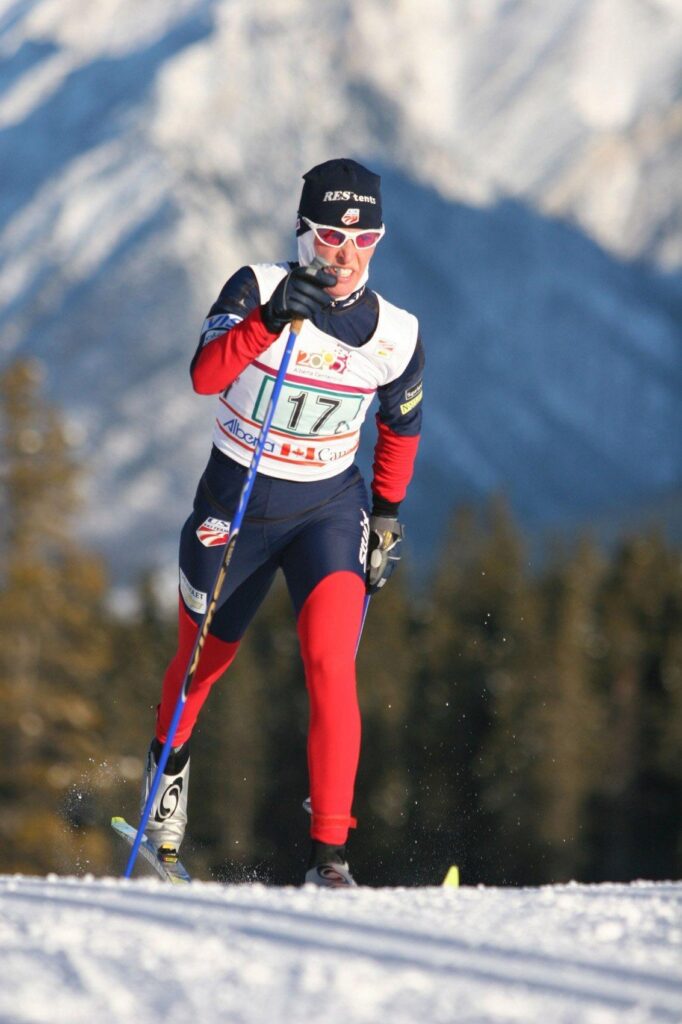
Cross-country skier Rebecca Dussault brought her faith to the 2006 Winter Games in Turin, Italy, 20 years ago.
Before her journey to the games, Dussault married her childhood sweetheart at 19 and credits her mother-in-law with igniting her faith life.
“She really had and has a deep interior life and that’s what she continually conveyed to us — the love and the mercy of Jesus Christ and the beauty and the depth and the heights of the Catholic faith,” she said. “She showed us the universal Church with such passion and consistently that we just couldn’t not fall in love with the faith.”
Dussault told OSV News recently that the games in Turin were special even though she didn’t come home with a medal. She traveled to the games with her husband and their then-4-year-old son cheering her on from the sidelines and used the occasion to spread devotion to then-Blessed Pier Giorgio Frassati, engraving his name on her Olympic ring.
St. Pier Giorgio Frassati, who was canonized in September, was an avid skier and mountain climber with the well-known motto “Verso l’alto” (“To the heights”).
Dussault still skis and enjoys time on her homestead in Idaho with her eight children and two grandchildren.
“If you can do sport in right conscience and be building the kingdom of God, then you’ve really latched on to some greatness,” she emphasized.
A speedskater-turned-Franciscan sister
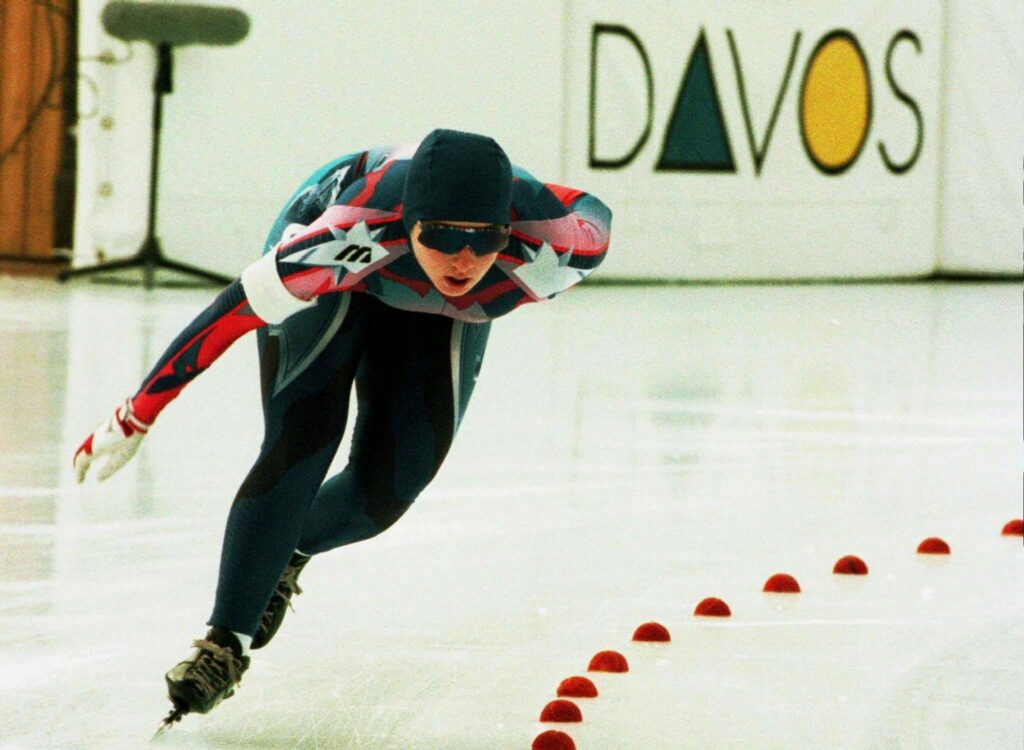
(OSV News photo/Steffen Schmidt, Reuters)
Kirstin Holum was a rising star in the world of speed skating at the Winter Olympics in Nagano. Her future looked bright as the youngest national junior champion speed skater at the age of 17. She placed sixth for Team USA in the 3,000 meters and seventh in the 5,000 meters.
Her mother and coach, Dianne Holum was a speed skating legend who won a gold medal at the Munich Games in 1972. She was also a devout Catholic who emphasized the importance of faith. She paid for her daughter to make a pilgrimage to the Marian shrine in Fatima, Portugal.
It was there at age 16 that Holum felt a sense of her vocation and the “powerful experience of realizing Jesus’ presence in the Blessed Sacrament.”
Rather than continuing her speed skating career, Holum chose to enter the Franciscan Sisters of the Renewal in the Bronx borough of New York City after finishing college.
She was later sent to open a new convent in England on the invitation of the bishop of Leeds. “I was asked to be a part of the first group of sisters who were sent over as missionaries,” she told NBC in 2018.
She said she had no regrets about the path she chose.
“I was not feeling in my heart that I would be skating the rest of my life; I knew there was more to life than sports,” she said in an interview with Catholic News Service. “I never regretted that decision. I think it was just a grace from God to bring me to something else.”
“The excitement and the joy of competing and doing well, even just doing your personal best, there’s a great thrill in that,” she told NBC. “But it was always a fleeting joy: You’re on to the next event, so you get nervous for that.”
“I think deep down, everyone is desiring to be great and to do something great,” she added. “It’s only when you get really in touch with God’s plan for you that you really find a peace in doing the great thing, whatever it might be.”
A hockey coach and priest sets an example of forgiveness
It was an unlikely sight at the 1964 Winter Olympics in Innsbruck, Austria: A Catholic priest coaching Team Canada was struck in the face by a broken hockey stick tossed by a Swedish player.
Father David Bauer, still bleeding from the blow, ordered his players not to retaliate against Sweden’s Carl-Göran Öberg — not wanting to take penalties in a close game which Canada won.
Father Bauer “returned to the arena the next day to scout the Czechoslovakia-Soviet Union game. He invited Öberg to sit with him, sending a message that he harboured no ill will toward the Swede.”
While Canada finished in fourth that year, Father Bauer was recognized for his sportsmanship in response to the incident with Öberg.
The brother of Boston Bruins star Bobby Bauer, Father Bauer was a successful junior hockey player in Canada in the 1940s. However, rather than entering the world of professional hockey, he followed a vocation to the priesthood with the Basilian order and began teaching at St. Michael’s College in Toronto and later St. Mark’s College at the University of British Columbia.
Taking a holistic approach to coaching, Father Bauer said, “If you can improve the boy as a person through virtues of hockey — courage, judgment, prudence, fortitude, teamwork and fair play, he will improve as a hockey player.”
Father Bauer was awarded the Order of Canada in 1967 for his contributions to the sport of hockey. The priest died in 1988 and he was inducted into the Hockey Hall of Fame in 1989.
The bobsledder staying on track with prayer
Curtis “Curt” Tomasevicz, a history-making gold and silver medalist in bobsled in the 2010 and 2014 Winter Olympic Games, said in a 2018 interview that his Catholic faith is what keeps his life on track.
“If I weren’t Catholic, I think my life would be the equivalent of a bobsled crash,” he said. “Being Catholic allows me to get my priorities straight and know that, despite what most people will tell you, athletic competitions are fleeting and you should not measure your self-worth through them.”
“My first crash — which lasted so long that I was able to pray three and a half Hail Marys before the sled stopped — was very jarring,” he recalled, “but I had to get back into things and not let fear take a hold of me. It was also a strong reinforcement of how I never pray to win, but so that everyone would compete to the best of their abilities and that no one would get hurt.
“At the end of my career, I had a void to fill due to my departure from bobsledding,” he emphasized. “I had grown accustomed to planning everything else around the sport, so there was a big transition when it was no longer there. This reinforced how important it is to me to be Catholic — being a part of the Church that Christ founded for our well-being. I was very motivated to be the best bobsledder I could be, but I didn’t let it become a god for me. If I had let that happen, the transition away from it would have been devastating rather than challenging.”
Now, Tomasevicz has returned to the Winter Games in a new capacity as director of sport performance for Team USA Bobsled in Milan.
Lauretta Brown is culture editor for OSV News. Follow her on X @LaurettaBrown6.
The post 6 Catholic athletes from past Winter Olympics inspire with stories of faith, endurance first appeared on OSV News.